How is the Longevity Benefit taxed?
When structured as non-qualified compensation, payouts are distributed in kind and may receive long-term capital gains treatment when shares are sold, depending on individual circumstances. When structured under ERISA, it can be held in a Roth account and taxed accordingly.
Is the Longevity Benefit insurance?
No. It is not insurance and is not regulated as such. It is an SEC-registered investment structure - a S&P 500 ETF-based index fund with a Longevity Bonus. Unlike insurance products, the Longevity Benefit does not involve an insurer assuming longevity risk and does not guarantee any specific payout amount.
How is Savvly different from an annuity?
Traditional annuities provide contractually guaranteed lifetime income but typically involve higher fees, limited market participation, and ordinary income tax treatment. The Longevity Benefit takes a fundamentally different approach: it is a capital markets structure that provides full S&P 500 participation, and a longevity reallocation bonus. Payouts follow a fixed milestone schedule; the amounts are not guaranteed. The upside is uncapped; the tradeoff is that outcomes depend on market performance and fund behavior. Consult a qualified tax advisor regarding your specific situation.
How can Savvly complement my 401(k) or IRA?
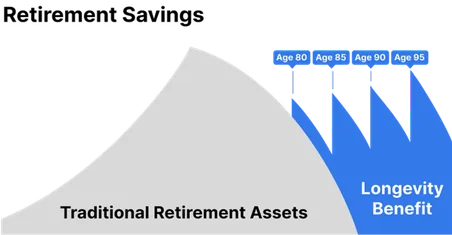
The Longevity Benefit is designed to work alongside, not replace, existing investment accounts. A 401(k) or IRA focuses on accumulation and drawdown through retirement. Savvly addresses what happens after that drawdown period ends: milestone income at 80, 85, 90, and 95. Combining both tools may strengthen long-term financial resilience, though outcomes depend on individual circumstances and market conditions.
What happens if I exit the fund before a payout date?
The early withdrawal value is calculated as 75% of your contribution plus an additional 1% for each year held, capped at 100%. This percentage is applied to the lesser of your original investment (excluding any sales load) or the current market value of the common shares, and is calculated for each remaining scheduled payout. When an investor exits early, their uncollected growth is reallocated to remaining investors rather than to an insurer. For a full breakdown of assumptions and legal disclosures, please review the fund prospectus.
How does Savvly protect investor money?
Contributions are invested in S&P 500 ETFs managed by Vanguard and Fidelity - two of the world's largest and most trusted asset managers. Assets are held in custody at U.S. Bank, a third-party fund custodian entirely separate from Savvly. Savvly never directly holds or manages investor assets.
What happens if I change jobs?
The Longevity Benefit is fully portable. If an investor changes employers, they maintain control of their account and may continue contributing personally. Their employer's contributions will stop, but the account itself, and all accrued potential benefits, remain with the investor. This portability is a key structural difference from employer-tethered benefits.
Are payouts guaranteed?
The schedule is certain; the amounts are not. Reaching a milestone age — 80, 85, 90, or 95 — while invested automatically triggers that milestone's payout: it's a fixed rule of the fund, not a discretionary decision. Live to 87, for example, and you receive the age-80 and age-85 payouts. What is not guaranteed is the dollar amount, which depends on S&P 500 market performance, fund size and behavior, and contribution amounts and timing. Savvly is not an insurance product and does not guarantee any specific income or return. Investment involves risk, including possible loss of principal.